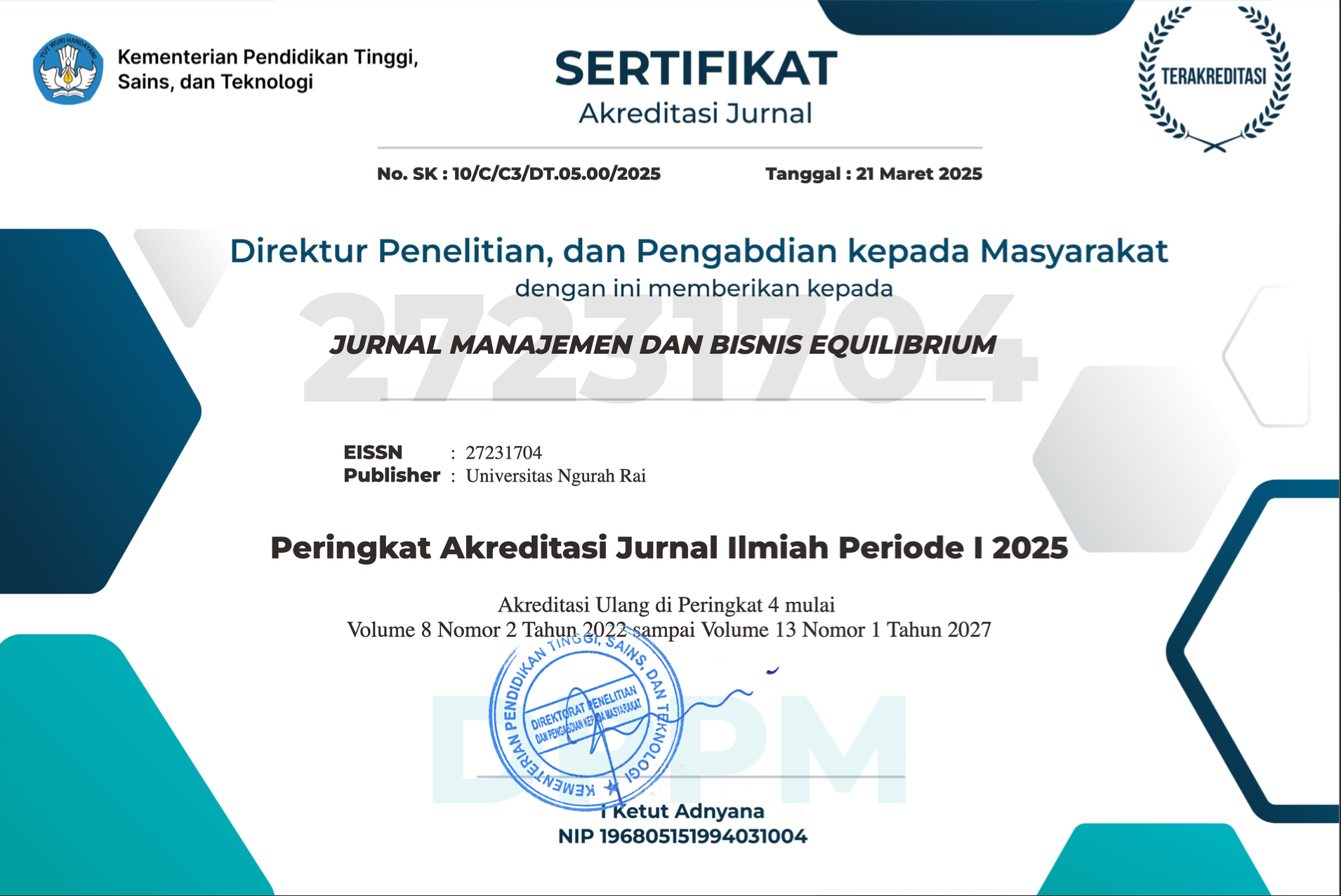
PENGARUH LITERASI KEUANGAN PERSEPSI KEMUDAHAN DAN PERSEPSI RISIKO TERHADAP KEPUTUSAN QRIS PADA USAHA MIKRO KECAMATAN BANGLI
DOI:
https://doi.org/10.47329/jurnalmbe.v12i2.1932Keywords:
Financial Literacy, Perceived Ease of Use, Perceived Risk, Decision to Use QRISAbstract
The development of digital technology has accelerated the transformation of payment systems toward cashless transactions through the use of the Quick Response Code Indonesian Standard (QRIS). Although QRIS adoption continues to increase, its utilization among micro enterprises is still influenced by several factors, including financial literacy, perceived ease of use, and perceived risk. This study aims to analyze the influence of financial literacy, perceived ease of use, and perceived risk on the decision to use QRIS among micro enterprises in Bangli District. This study employed a quantitative approach with a causal associative research design. The population consisted of micro enterprises in Bangli District that use QRIS. The sampling technique used was purposive sampling, resulting in a sample of 90 respondents. Data were collected through questionnaire distribution. The data were analyzed using multiple linear regression analysis with the assistance of Statistical Package for Social Science (SPSS) version 26.0. The results indicate that financial literacy has a positive and significant effect on the decision to use QRIS. Perceived ease of use has a positive and significant effect on the decision to use QRIS. Perceived risk also has a positive and significant effect on the decision to use QRIS. Simultaneously, financial literacy, perceived ease of use, and perceived risk significantly influence the decision to use QRIS among micro enterprises in Bangli District. Financial literacy, perceived ease of use, and perceived risk explain 73.4 percent of the variation in the decision to use QRIS, while the remaining 26.6 percent is explained by other variables outside the scope of this study. The findings suggest that improving financial literacy, enhancing system usability, and managing perceived risk effectively can encourage micro enterprises to adopt QRIS in their business transaction activities.
References
Adiandari, A. M., Wijayanti, L. M. S., & Geriadi, M. A. D. (2025). Assessing the Determinants of E-Wallet Adoption: Financial Literacy, Security and Convenience Perception in Kalibukbuk Lovina Village. Quality Access to Success, 26(207). https://doi.org/10.47750/QAS/26.207.47
Anggraini, R. P., Mubyarto, N., & Addiarrahman, A. (2023). Analisis Technology Acceptance Model dan persepsi risiko terhadap minat bertransaksi mobile banking nasabah Bank Syariah Indonesia di Kota Jambi. Jurnal Ilmiah Ekonomi Islam, 9(1), 1576–1588. https://doi.org/10.29040/jiei.v9i1.8311
Anisah, S., & Amaniyah, E. (2023). Pengaruh literasi keuangan, risiko transaksi, dan kemudahan terhadap minat penggunaan QRIS pada UMKM di Sampang. JAFM: Journal of Accounting and Finance Management, 5(5), 1–12. https://doi.org/10.38035/jafm.v5i5.1056
Aswati, W. O., Intihanah, & Renalda, D. I. (2024). Pengaruh manfaat dan risiko terhadap penggunaan Quick Response Code Indonesian Standard (QRIS). Jurnal Akuntansi dan Keuangan, 9(2), 555–569. https://doi.org/10.33772/jakuho.v9i2.211
Azzahra Mutiara Perdani, T., Fitriati, A., Kusbandiyah, A., & Nur Azizah, S. (2025). Pengaruh persepsi manfaat dan persepsi risiko terhadap niat penggunaan berkelanjutan QRIS yang dimediasi oleh kepercayaan pada Generasi Z. Journal of Accounting and Finance Management, 6(2), 791–808. https://doi.org/10.38035/jafm.v6i2.1984
Bank Indonesia. (2024). Statistik Sistem Pembayaran dan Infrastruktur Pasar Keuangan (SPI-IPK). Bank Indonesia. https://www.bi.go.id/id/publikasi/statistik/sistem-pembayaran
Davis, F. D. (1989). Perceived usefulness, perceived ease of use, and user acceptance of information technology. MIS Quarterly, 13(3), 319–339.
Ghozali, I. (2016). Aplikasi Analisis Multivariete SPSS 23. Badan Penerbit Universitas Diponegoro.
Ghozali, I. (2018). Aplikasi Analisis Multivariate dengan Program IBM SPSS 25. Badan Penerbit Universitas Diponegoro.
Hapsari, N. A., Affiat, M. R., Sulistyaningsih, E., Gani, I. M., Dewi, N. R., & Ridhayantho, M. (2026). Pengaruh literasi keuangan digital dan adopsi fintech terhadap kinerja keuangan UMKM kuliner di Bandung. Jurnal Multidisiplin West Science, 5(1), 50–60. https://doi.org/10.58812/jmws.v5i01.3152
Hidayati, N., & Karim, N. K. (2024). Pengaruh perceived ease of use dan perceived usefulness terhadap minat penggunaan QRIS pada merchant di Lombok Epicentrum Mall. Ganec Swara, 18(1), 253. https://doi.org/10.35327/gara.v18i1.756
Kristian, J., & Setyawan, I. (2024). Peningkatan kualitas keputusan investasi melalui literasi keuangan digital. Jurnal Manajemen Bisnis dan Kewirausahaan. https://doi.org/10.24912/jmbk.v8i2.29695
Nasution, I. H., Purnama, Y. H., Rahmat, & Frimayasa, A. (2025). Analisis keputusan menggunakan QRIS pada UMKM dengan perspektif persepsi kemudahan dan persepsi kegunaan melalui minat sebagai variabel mediasi. Socius: Jurnal Penelitian Ilmu-Ilmu Sosial, 7(2), 118–126. https://doi.org/10.5281/zenodo.14944004
Nurrohmah, A., & Nuryani, Y. (2025). Pengaruh persepsi kemanfaatan dan kemudahan terhadap keputusan penggunaan digital payment QRIS pada UMKM di Kabupaten Bandung. Cakrawala: Jurnal Ekonomi Manajemen dan Bisnis, 2(3), 508–517. https://doi.org/10.70451/cakrawala.v2i3.635
Oktaviranti, D., & Alamsyah, D. P. (2023). Financial literacy and financial decision-making for MSMEs. Jurnal Manajemen Keuangan, 12(2), 101–115.
Putri, N. M., Lakoni, I., & Safrianti, S. (2023). Pengaruh literasi keuangan, kemudahan, dan kepercayaan terhadap keputusan bertransaksi menggunakan QRIS pada UMKM di Kota Bengkulu. E-Bisnis: Jurnal Ilmiah Ekonomi dan Bisnis, 16(2), 356–364. https://doi.org/10.51903/e-bisnis.v16i2.1259
Rachmawati, F. F., Sudarno, S., & Sabandi, M. (2023). Pengaruh literasi keuangan dan lingkungan sosial dimoderasi tingkat pendidikan terhadap penggunaan QRIS pada pelaku UMKM di Kota Surakarta. Jurnal Ekonomi Pendidikan dan Kewirausahaan, 11(1), 21–36. https://doi.org/10.26740/jepk.v11n1.p21-36
Rahardjo, W. S. (2025). Analisis manfaat dan kendala adopsi QRIS pada UMKM: Temuan survei lapangan di wilayah Ciayumajakuning. Journal of Economics and Business UBS, 14(6), 1610–1620. https://doi.org/10.52644/qkdwe827
Rayhan, M., Nursaidah, N., & Dian, T. (2025). Pengaruh persepsi manfaat, kemudahan, kepercayaan, dan risiko terhadap keputusan penggunaan QRIS pada UMKM se-Kota Jember. Jurnal Ekonomi, Manajemen, Akuntansi dan Keuangan, 6(3), 13. https://doi.org/10.53697/emak.v6i3.2759
Riduwan, & Akdon. (2020). Rumus dan Data dalam Aplikasi Statistika (7th ed.). Alfabeta.
Sari, S. P., & Widoatmodjo, S. (2023). Financial literacy and personal financial behavior. Jurnal Bisnis & Akuntansi, 25(1), 77–88.
Saufudin, F., Satriya, B., Amali, I., Eko, M., & Kalla, Z. (2025). Pengaruh persepsi manfaat, kepercayaan, dan kemudahan penggunaan terhadap minat menggunakan QRIS. Determinasi: Jurnal Ekonomi Manajemen dan Akuntansi, 3(2), 256–266. https://doi.org/10.23917/determinasi.v3i2.476
Sugiyono. (2021). Metode Penelitian Kuantitatif, Kualitatif, dan R&D (Edisi Kedua). Alfabeta.
Zusrony, E., Anzie, M. P., Asti, P., Manalu, G., Permana, I., & Imaliya, T. (2023). Analisis perceived usefulness, perceived ease of use, dan perceived risk terhadap minat penggunaan QRIS pada pelaku UMKM. Jurnal Ilmiah Ekonomi dan Bisnis, 16(1), 200–206. https://doi.org/10.51903/e-bisnis.v16i1.1211
Published
Issue
Section
License
Copyright (c) 2026 Ni Komang Latri Yudani, Ade Maharini Adiandari, Made Ayu Desy Geriadi

This work is licensed under a Creative Commons Attribution-ShareAlike 4.0 International License.
This work is licensed under a Creative Commons Attribution-ShareAlike 4.0 International License.